
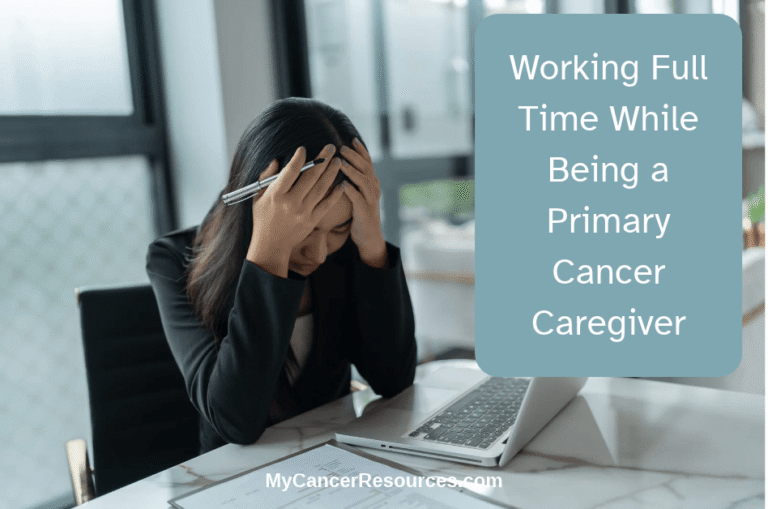
You’re doing the impossible, and there’s no manual on how to handle it all.
Working full-time while being a cancer caregiver (or even working part-time) is a heavy load. Both roles demand everything you have.
You’re on conference calls while mentally calculating medical bills.
You’re sitting in hospital waiting rooms answering work emails.
You’re exhausted, stretched thin, and wondering how long you can keep this up.
The guilt is neverending, and the psychological distress off the charts.
Spend too much time at work, and you feel like you’re abandoning your loved one.
Spend too much time caregiving, and you worry you’re letting your team down or risking your job.
Neither role sees what the other demands from you.
But you’re not alone in this. As an oncology social worker, I’ve worked with caregivers experiencing this struggle. I helped them figure out how to juggle their responsibilities in a way that worked for them.
There are ways to navigate this stresssful time without completely losing yourself.
What It Means to Be a Full-Time Caregiver With a Full-Time Job
This is the reality nobody warns you about.
Being a caregiver while working full-time is so tough. You’re managing two worlds that both need to come first, sometimes at the same time.
As a caregiver, you’re coordinate appointments, providing emotional support, and managing side effects. At work, you’re scrambling to stay afloat while attending meetings, and meeting deadlines.
Both roles are essential, and both are exhausting. Both demand more hours than a day holds.
What makes this different from just being busy:
- You can’t pause cancer treatment to meet a work deadline. Medical appointments, chemo sessions, and ER visits don’t bend around your calendar.
- Work obligations don’t disappear because your loved one had a bad night. Clients still expect deliverables and projects need completion. Your bills still need paying.
- Emotional energy gets split between supporting someone through cancer and maintaining work relationships. You’re managing your loved one’s fear while suppressing your own.
- Sleep becomes a luxury you can barely afford. Caregiving doesn’t end at 5 p.m. Nor does stressing about unfinished work when you left early for an appointment.
You’re not just busy. You’re living two realities that both need your full attention. There’s no amount of time management tips that can change that.
The strain is real, your exhaustion is justified, and your overwhelm is understandable.
The Three Hardest Parts Nobody Talks About
The logistics are brutal, but the emotional weight really breaks you down.
Everyone says “Oh, create a schedule“, or “Ask other people to help“. Yes, these can be helpful, but they ignore the heavy mental and emotional load you’re carrying.
These are the hidden struggles that make being a cancer caregiver so uniquely hard:
1. The guilt operates on a loop that you can’t escape
You feel guilty for working when your loved one needs you. You feel guilty for taking time off when your coworkers have to pick up slack.
You feel guilty for being tired when they’re the one going through cancer treatment. You feel guilty for wanting a break when they don’t get one from their illness.
The guilt comes from every direction and never stops.
2. Your job becomes your only space that isn’t about cancer, but you can’t fully be there either
Work is the one place where cancer isn’t the main topic. For a while, you get to think about something else. It should feel like relief, but doesn’t because your attention is scattered.
In a meeting, you’re wondering if their pain is under control. You’re reviewing a report, but thinking about leaving early for a doctor’s appointment.
You’re never fully present anywhere, which makes it feel like you’re failing in both roles.
3. People expect you to either be the caregiver or the employee, not both
Your job sees you as an employee who sometimes needs time off for personal reasons. Your loved one and their medical team see you as the primary caregiver who happens to have a job.
Neither side sees the full picture of what you’re actually doing. Neither one fully understands why you can’t just give them more of yourself.
This isn’t about working harder or being more organized. It’s about carrying an emotional load that most people never have to balance. And you’re doing it without a finish line in sight.
Rights and Protections You Have at Work
You have more legal protections than you probably realize.
Most caregivers also working full-time job don’t know what benefits they’re entitled to. You’re so focused on just surviving. It doesn’t even cross your mind to ask what your employer is actually required to provide.
These protections exist for situations like yours. Knowing them can take some of the pressure off of you.
Family and Medical Leave Act (FMLA) provides up to 12 weeks of unpaid leave each year to care for a seriously ill family member. Your job is protected during this time. You can take it all at once or in smaller chunks for medical appointments and treatment days.
Americans with Disabilities Act (ADA) can require some work changes if caregiving stress has led to anxiety or depression. You may be able to have a flexible schedule, remote work options, or modified job duties.
State and local leave laws sometimes are better than federal laws. Some states provide paid family leave or extended timeframes. Your state might provide coverage for smaller employers that aren’t covered by FMLA.
Employer-specific policies might include caregiver leave, flexible scheduling, employee assistance, or remote work.
Some companies even have pools where employees donate their unused time off. It’s then available for teammates to use when they have these type of complex situations.
Talk with someone in Human Resources at your company to see if any of these are options they offer.
Knowing your rights certainly doesn’t make this experience easier. It does give you some leverage to be able to juggle both responsibilities.
Don’t assume you have to tough this situation out on your own.
How to Manage Working and Caregiving Without Losing Your Mind
This isn’t about creating a perfect balance (because there’s no such thing). This next section is about sharing strategies that have helped many cancer caregivers I’ve worked with.
At work:
- Talk to your manager about your situation. You don’t have to share every detail, but it’ll help your manager know why you might need flexibility.
- Batch your work around caregiving schedules. If you know that the day after treatment is the hardest for your loved one, plan lighter work tasks for that day. Work on the projects that need more focus when you have longer blocks of uninterrupted time.
- Use every tool your workplace offers. These aren’t luxuries – they’re necessities, so use them without guilt.
- Set boundaries around your availability. You can’t be on call 24/7 for work emails when you’re managing cancer treatment schedules. Communicate your available hours clearly and stick to them when possible.
At home and in caregiving:
- Accept that you can’t do everything yourself. You’re not admitting defeat if others pick up prescriptions or bring meals. Let them help you.
You don’t win an award for carrying this load alone. - Keep a shared medical binder or digital document. The Holistic Cancer Toolkit tracks meds, appointments, and side effects in one place. Having everything organized can greatly reduce your stress.
It doesn’t force you to rely on your memory when life is overwhelming. It also keeps other family members up to date on what’s going on so they’re in the know when they step in to give you a break.
- Connect with your loved one’s care team about your work schedule. Oncology nurses and social workers understand that caregivers have jobs. Sometimes appointments can be scheduled at more convenient times for you.
Oncology social workers can also connect you to resources to lighten your load. Financial assistance programs can relieve some money stress. These are especially helpful if you need to work fewer hours while caregiving. - Build in tiny pockets of rest. Holding out until you can take a full spa day or vacation is not the way to go. You’ll burn out long before then.
So think about ways you can grab just a few minutes to yourself. Sit in the car and scroll on your phone for five minutes before walking into the house.
Take ten minutes of quiet before logging into your morning meeting. Micro-breaks keep you functioning when longer rest periods aren’t possible.
When someone offers to stay with your loved one so you can get away, do it!!! And don’t take the time to do work stuff – keep the computer closed.
Go for a walk, to a movie, or soak in the tub. Meet up with friends you haven’t seen in a while. Whatever will give you time to feel a bit rejuvenated when you’re done.
The goal isn’t balance. You’ll never be able to split responsibilities 50/50, so don’t even put that added pressure on yourself.
The goal is making it through the day with both responsibilities handled well enough. And keeping yourself intact enough to do it again tomorrow.
What to Do When You're Reaching Your Breaking Point
Burnout isn’t a sign of weakness. It’s a signal that what you’re doing is unsustainable.
You’re going to hit walls. There will be days when you can’t get out of bed, and moments when you snap at people who don’t deserve it.
There’ll be times when you fantasize about disappearing just to escape the pressure.
That’s not you failing. That’s your mind and body telling you they’ve exceeded capacity.
Recognize the signs before you completely crash
These are just some of the signs of burnout:
You’re getting sick more often.
You’re making mistakes at work you wouldn’t normally make.
You’re feeling resentment toward your loved one or your job.
You’re losing interest in anything outside of work and caregiving.
You’re having trouble sleeping even when you finally get the chance.
You feel numb instead of sad or worried.
When you spot these signs, take them seriously!
- Talk to a therapist who specializes in caregiver stress. Many cancer centers have social workers or counselors available to caregivers for free. Employee assistance programs through your job often include free therapy sessions.
- Look into respite care options. Respite care is temporary help so that you can step away. It could be a professional caregiver, family member or friend who stays with your loved one for a few hours.
Remind yourself that this is necessary for your own mental and physical health. You’re not abandoning your loved one by taking a break.
- Think about adjusting your work arrangement. You can reduce hours, or move to part-time work. You may be able to take a leave of absence, or step back from certain responsibilities.
Your career can recover, but your health is harder to rebuild.
- Join a support group for caregivers. The support you get from talking to people who understand exactly where you are is crucial. It’s grounded in their real-life experiences.
Compare this with to well-meaning friends who want you to feel better, but can’t relate, so have no insight.
Lots of support groups meet virtually, so it may be easier to fit into your busy hectic schedule.
Reaching your limit doesn’t mean you’re not strong enough. It means you’re human, and what you’re attempting is genuinely one of the hardest things a person can do.
Resources That Can Help
You don’t have to figure this out alone.
There are organizations and programs built specifically to support family caregivers. These resources can take tasks off your plate or provide support when you’re running on empty.
- Cancer support organizations include the American Cancer Society, CancerCare, and Blood Cancer United (formerly the Leukemia & Lymphoma Society). They offer free resources, support groups, and practical help like transportation to treatment.
- Your loved one’s cancer center probably has a social worker or oncology nurse navigator to connect you to available resources. They’ll know about local programs and you won’t find through a Google search.
- Caregiver-specific organizations like the Caregiver Action Network exist specifically to support you.
- Online communities and forums connect you with other caregivers managing similar situations. Knowing that someone gets what you’re going through helps you to keep going.
- Meal or grocery delivery services or housecleaning cost money, but they free up your time. Some community organizations may offer these services free to cancer patients and caregivers.
Asking for help or using resources isn’t giving up. It’s the way most people survive this journey without sacrificing their own health.
You’re doing something incredibly hard, because someone you love needs you.
That is certainly important, and it matters, but so do you and so does your own mental health.
This season of your life won’t last forever, even though right now it may feel endless.
Cancer treatment has stages, and caregiving evolves. Your capacity will shift.
You can survive this time of juggling many big responsibilities. But you must give yourself permission to be imperfect and ask for help when it’s needed.
You don’t have to be superhuman. You just have to be sure to put on your own oxygen mask first. Then keep going, one day at a time (or even just an hour at a time on the really hard days).
Remember that you’re not alone.
And if you need help locating a resource, send me a message or connect on social media. I’ll do the best I can to help out!